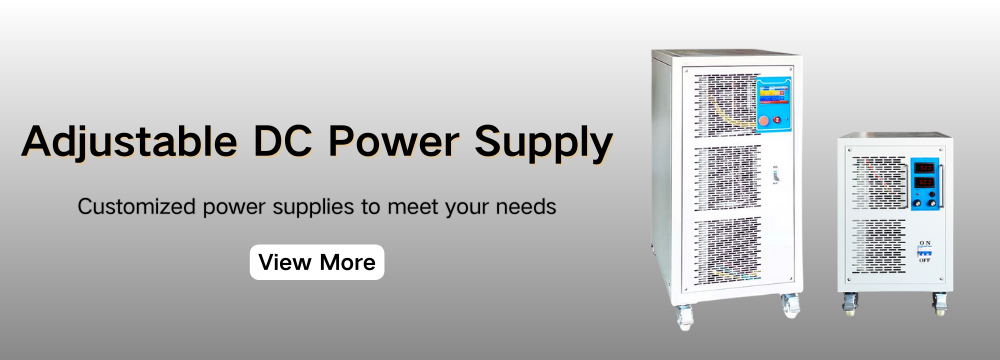
In water treatment engineering, high-power power supplies serve as the core power components for processes such as electrocoagulation, electrocatalysis, electrodialysis, and electrolytic oxidation. Their parameter matching directly determines the stability, energy consumption, and treatment efficiency of water treatment. Many projects only focus on power rating during selection, ignoring key indicators deeply adapted to water treatment processes, leading to low operating efficiency, fast electrode wear, and high energy consumption in later stages. Combined with practical engineering applications, this paper summarizes the core technical parameters of high-power supplies in water treatment scenarios, providing a reference for equipment selection and system commissioning.
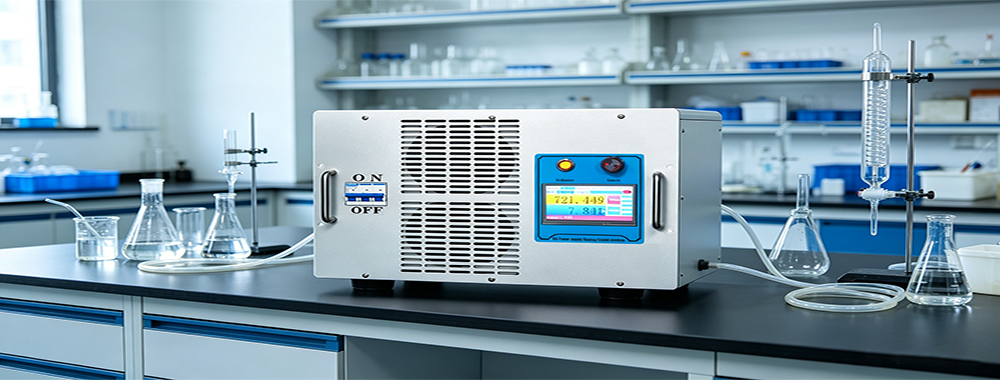
1. Basic Output Electrical Parameters
Power, voltage, and current are basic indicators for matching high-power supplies to water treatment systems. Water treatment mostly operates under low-voltage and high-current conditions, with voltages commonly ranging from 12V to 600V, and some advanced oxidation processes reaching 0–800V. Current is adjustable from hundreds to thousands of amperes, and power covers tens of kilowatts to megawatts, meeting the needs of different-scale water treatment such as municipal sewage, industrial wastewater, and seawater desalination pretreatment. Multi-mode switching of constant current/constant voltage/constant power can adapt to complex working conditions such as water quality fluctuations, electrode fouling, and cell voltage changes, ensuring continuous and stable water treatment reactions.
2. Pulse and Waveform Control Parameters
Pulse-related parameters significantly affect the efficiency of electrocatalytic and electrocoagulation water treatment. The frequency range is generally adjustable from 10Hz to 100kHz, with a duty cycle continuously adjustable from 1% to 99%. Coupled with microsecond-level fast response edges, it can enhance ion migration, reduce electrode polarization, and improve pollutant degradation efficiency. Periodic commutation and intelligent electrode reversal functions suppress electrode fouling, extend electrode service life, and reduce operation and maintenance costs for water treatment—an important feature distinguishing high-power supplies from ordinary industrial power supplies.
3. Precision and Ripple Control Parameters
Electrochemical reactions in water treatment have strict requirements for output stability. The current stabilization accuracy is usually required to be ≤±1%, the ripple coefficient is controlled within 3%, and some high-precision models can reach ≤1%, avoiding current fluctuations that affect reaction uniformity and preventing local over-electrolysis or incomplete treatment. High-precision output improves the removal rates of COD, ammonia nitrogen, and heavy metals, ensuring stable compliance of water treatment effluent indicators.
4. Conversion Efficiency and Energy-Saving Parameters
High-power supplies operate at full load for a long time, and energy efficiency directly affects water treatment operating costs. High-quality models have a conversion efficiency of ≥92%, high-frequency schemes can reach over 95%, and a power factor of ≥0.9, significantly reducing power consumption per ton of water and adapting to long-term continuous operation of large water treatment stations. High-efficiency topology and intelligent frequency conversion adjustment dynamically adjust output according to water quality load, further reducing overall energy consumption.
5. Environmental Adaptation and Protection Parameters
Water treatment sites are mostly humid, corrosive, and dusty, so power supplies need strong environmental adaptability. They support protection levels above IP54, meet the insulation withstand voltage standard of AC1500V/60s, and have multiple protections such as overvoltage, overcurrent, short circuit, overheating, phase loss, and reverse connection, ensuring reliable operation in harsh environments. Some customized models can be treated with anti-corrosion treatment, adapting to strong corrosion scenarios such as acid-base wastewater treatment.
6. Control and Communication Parameters
Modern water treatment systems tend to be intelligent. High-power supplies need to support DSP/PLC digital control, with parameter storage, remote monitoring, and fault diagnosis functions, compatible with communication protocols such as Modbus, and can be connected to the central control system for fully automatic operation. One-click parameter call and multi-machine parallel expansion meet the centralized control needs of large water treatment projects.
In the practice of water treatment engineering, parameter matching of high-power supplies is far more important than simply pursuing high power. Reasonably selecting voltage and current, optimizing pulse waveforms, improving control accuracy and environmental adaptability can deeply integrate power supplies with water treatment processes, achieving efficient, stable, and low-consumption operation. YIBENYUAN has mature customized solutions in the field of high-power special power supplies for water treatment, and can provide precise parameter configurations according to different water treatment processes, helping projects achieve stable compliance and energy efficiency.