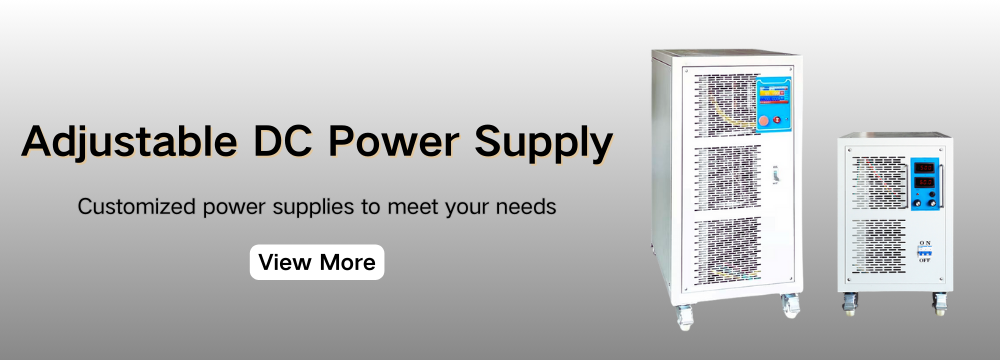
In the electroplating industry—whether for decorative plating (such as chrome or nickel plating on hardware) or industrial functional plating (such as hard chrome coatings on automotive components or tin plating on electronic parts)—an adjustable DC power supply is an indispensable piece of core equipment, often hailed as the "power core" of electroplating production. Many industry newcomers often wonder: Can a standard DC power supply serve as a substitute for an adjustable one? Why is it necessary to incur higher costs to select adjustable equipment?
First, it is crucial to understand the core principle of electroplating: the process of electrodeposition. Driven by a direct current, metal ions suspended in the plating solution are deposited uniformly onto the surface of the workpiece, forming a dense, even metal coating with excellent adhesion. This process demands extremely high stability and precision regarding power supply parameters (current and voltage). Standard DC power supplies, with their fixed output parameters, cannot dynamically adapt to changing electroplating conditions. When applied to electroplating production, they frequently lead to defects such as peeling, discoloration, uneven thickness, and insufficient gloss—or even result in the scrapping of workpieces—thereby inadvertently increasing production costs.
The First Core Reason: The inherent diversity of electroplating processes dictates the absolute necessity for "adjustability." Different plating materials and different workpieces have vastly different requirements for current and voltage; no single power supply with fixed parameters can adequately accommodate every scenario.
Take decorative nickel plating as an example: it requires a low current density and low voltage supply—typically controlled within a range of 0.5–2 A/dm² for current density and 1–3 V for voltage—to ensure a fine-grained finish and achieve the required level of gloss while avoiding defects such as roughness or pinholes. In contrast, hard chrome plating is a high-power electroplating process that demands high current density and high voltage support; current densities may reach 10–20 A/dm², and the voltage must be adjusted to between 5–15 V to guarantee that the coating's hardness and wear resistance meet industrial performance standards. A standard power supply with fixed parameters cannot simultaneously satisfy the requirements of both processes, making it incapable of supporting normal production operations.
Furthermore, even within a single electroplating procedure, the specific requirements for power supply parameters often vary across different stages of the process. During the initial stages of electroplating, before a metallic coating has fully formed on the workpiece surface, the interfacial impedance is relatively low. Consequently, a low starting current is required to prevent excessive current from causing surface burn damage or coating detachment. Once the coating begins to take shape, the current must be gradually increased to ensure uniform coating growth. This dynamic adjustment of parameters can only be achieved through the use of an adjustable DC power supply.
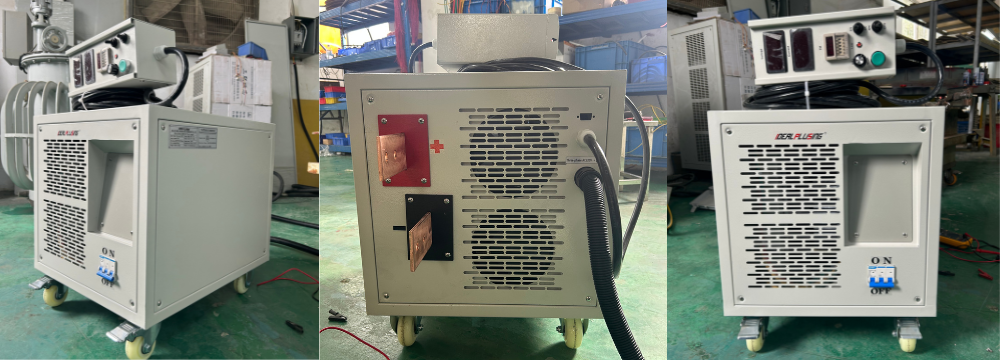
Equally critical is the role that adjustable DC power supplies play as the “quality lifeline” of electroplating, safeguarding the uniformity and adhesion of metal coatings. Never to be overlooked are the common defects in electroplating: uneven coating thickness, flaking and peeling. Rooted in unstable voltage and current are nearly all such failures.
Low in output accuracy and prone to parameter drift are conventional DC power supplies. For example, from a preset 2V may the output voltage surge to 2.5V, and even more dramatic are the fluctuations in current. Such inconsistent outputs lead to unbalanced deposition rates of metal ions in the plating bath, resulting in uneven film thickness on the workpiece surface. Even worse, burning defects may appear, severely weakening coating adhesion and ruining product quality.
By contrast, exceptional in output accuracy are adjustable DC power supplies, maintaining errors within ±0.1% and ensuring steady, fluctuation-free voltage and current. Capable of real-time fine-tuning are these power supplies, adapting automatically to changes in bath concentration and temperature. For instance, when rising bath temperature accelerates metal ion activity, lowered output voltage can prevent excessively fast deposition and rough surfaces. When bath concentration declines, finely adjusted current parameters guarantee consistent coating thickness. Only through such precise regulation can manufacturers achieve stable high-quality output and effectively reduce rework and scrap rates.
Equally remarkable is the adaptability of such power supplies to diverse workpieces, streamlining operations and lifting production efficiency. Greatly varied in shape, size and material are electroplated workpieces, from miniature electronic components to large industrial hardware, and vastly different are their voltage and current demands.
Featuring wide-ranging output capability are adjustable DC power supplies, with voltage continuously adjustable from 0–100V and current from 0–1000A. Fully satisfied by this flexibility are the needs of both precision plating for small parts and large-scale industrial plating. Supported by most models is the smooth switching between constant voltage and constant current modes. For tin plating, employed is constant current mode to ensure uniform thickness; for copper plating, adopted is constant voltage mode to enhance surface gloss. Simplified and efficient is the operation, thus markedly improving productivity.
Effective in cutting production costs and extending bath life are adjustable DC power supplies as well. Unable to match changing process conditions are fixed-parameter conventional power supplies, often leading to excessive bath consumption. When current is excessively high, accelerated is the consumption of metal ions and increased are the harmful byproducts, shortening bath life and raising material costs. Maintained at optimal working status by adjustable power supplies, the bath generates fewer byproducts and enjoys a longer service life. Reduced significantly over the long term are the overall production costs.
In summary, central to electroplating production is precise electrical control, and indispensable for achieving this goal is the adjustable DC power supply. Meeting the power demands of various processes and workpieces, stabilizing plating quality, simplifying operations, improving efficiency and controlling costs are all enabled by this key equipment. Never an optional accessory but an essential investment for production stability and quality competitiveness is the adjustable DC power supply in the electroplating industry. For this reason, regarded as must-have equipment are adjustable DC power supplies by electroplating enterprises of all types and scales.
Please do not hesitate to contact us.!