In the design and selection of industrial power supplies, the rectifier circuit serves as the core part for converting alternating current to direct current, which directly determines the stability, efficiency, ripple level and long-term reliability of the power supply. The three basic rectifier types—half-wave, full-wave and bridge—differ greatly in structure, performance and application scenarios. A reasonable choice can only be made by matching the actual working conditions of industrial power supplies. Combined with field requirements, this paper compares and analyzes the three rectifier circuits to help engineers make proper decisions.
Core Characteristics of the Three Rectifier Circuits
The half-wave rectifier has the simplest structure, using only one diode for unidirectional conduction. It utilizes only half a cycle of the AC input, resulting in low average DC output voltage, large ripples, heavy filtering burden and low conversion efficiency. Though with extremely low cost and simple wiring, its poor output quality hardly meets the stability requirements of mainstream industrial power supplies, and is only suitable for low-power auxiliary circuits with loose power demands.
The full-wave rectifier adopts a center-tapped transformer and two diodes to utilize both positive and negative half-cycles. It provides higher average output voltage and doubled ripple frequency, thus easing filtering. However, it depends on a special transformer that requires strictly symmetrical windings, leading to larger size, higher cost, and higher reverse voltage withstand requirements. Such drawbacks increase structural and thermal loads in high-power industrial power supplies, limiting its popularization.
The bridge rectifier consists of four diodes in a bridge configuration, working with a ordinary single winding transformer instead of a center-tapped one. It combines the high efficiency of full-wave rectification and a compact structure, featuring smooth output, small ripples, high transformer utilization, balanced device stress and wide adaptability to voltage and power levels, making it the most balanced rectifier solution for industrial power supplies.
Selection Logic for Industrial Power Supply Scenarios
Industrial power supplies operate for a long time under continuous load, grid fluctuations and strong electromagnetic interference, with much higher requirements for reliability, efficiency and maintainability than civilian products. Due to large ripples and low efficiency, half-wave rectifiers cannot support core loads such as motor drives, industrial control equipment, electroplating and electrolysis, and are only usable for non-critical branches like indicator lights and small control boards.
Although full-wave rectifiers outperform half-wave ones, the special transformer raises cost and volume, and increases difficulty in heat dissipation and layout under high power, which is unfavorable to modular and standardized design of industrial power supplies, thus hard to be widely applied.
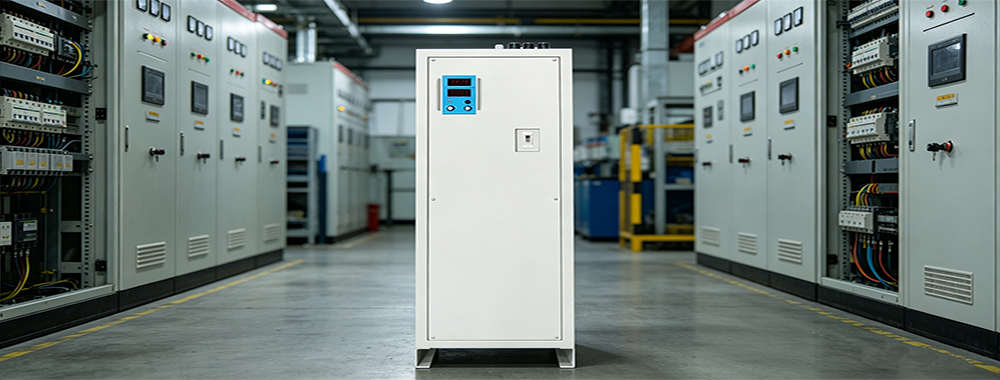
Bridge rectifiers have outstanding advantages in industrial power supplies: small output ripples facilitate post-stage voltage stabilization and filtering to improve power quality; high universality of transformers reduces material cost and inventory pressure; mature devices and circuits feature strong anti-interference and overload capacity adapted to industrial environments; wide power coverage supports stable operation from low-power industrial control power supplies to high-power rectifier cabinets. Overall, bridge rectification better meets the demand for long-term stable operation of industrial power supplies.
Summary and Engineering Recommendations
The selection of industrial power supplies should prioritize reliability, efficiency and maintainability. Half-wave rectifiers are suitable for ultra-low-power and low-demand occasions; full-wave rectifiers are limited by transformer structure and difficult to popularize; bridge rectifiers have become the mainstream choice for industrial power supplies due to their balanced performance. In practical design, the output can be further optimized by combining filtering and voltage stabilizing circuits to meet the power supply requirements of precision industrial equipment. In industrial rectifier power supply solutions, YIBENYUAN mostly adopts bridge rectifier as the basic topology, balancing stable output and engineering practicality to provide reliable power support for industrial sites.