Hard anodization is widely used to improve the surface hardness, wear resistance, and corrosion resistance of aluminum components. It is commonly applied to industrial machinery parts, automotive components, aerospace-related equipment, and precision mechanical products.
However, achieving consistent hard anodization coating quality can be challenging. Coating thickness, hardness, surface appearance, and uniformity are influenced by several factors, including electrolyte temperature, bath composition, current density, treatment time, and electrical output stability.
The power supply plays an important role in controlling the electrical conditions of the anodizing process.
Compared with conventional continuous DC operation, pulse power technology provides additional flexibility in controlling current delivery. Under suitable process conditions, this can help manufacturers manage heat generation and improve process consistency.
Understanding how pulse power works can help engineers determine whether a pulse-capable adjustable DC power supply is suitable for their hard anodization production line.
1. Industry Pain Points
Hard anodization requires careful control of electrical and chemical process conditions. Several challenges can affect coating quality.
1.1 Uneven Coating Thickness
Differences in current distribution across complex workpiece geometries may result in uneven coating growth.
Parts with holes, edges, recessed areas, or varying surface geometries can present additional process-control challenges.
1.2 Excessive Heat Generation
Hard anodizing commonly operates under demanding electrical conditions. Heat generated during the process can affect electrolyte temperature and coating formation.
If temperature is not adequately controlled, coating uniformity and process stability may be affected.
1.3 Surface Defects and Process Variation
Excessive local current density, unstable electrical output, and inadequate cooling can contribute to surface defects or inconsistent coating characteristics.
These problems may increase inspection requirements, rework, and production costs.
1.4 Limited Control with Conventional DC
A conventional DC power supply provides continuous current output. Although suitable for many anodizing applications, it may offer less flexibility when a process requires more advanced control of current delivery.
Pulse power introduces additional control parameters that can be evaluated for demanding anodizing applications.
2. Working Principle: How Pulse Power Works in Hard Anodization
A conventional DC power supply delivers relatively continuous DC output during anodizing.
A pulse power supply, by comparison, periodically switches its output between defined operating states.
Typical pulse parameters include:
Peak Current: Current level during the pulse-on period.
Pulse Frequency: Number of pulse cycles per second.
Duty Cycle: Percentage of each cycle during which the output is active.
Pulse-On Time: Duration of the active current period.
Pulse-Off Time: Interval between active pulses.
Conceptual pulse waveform
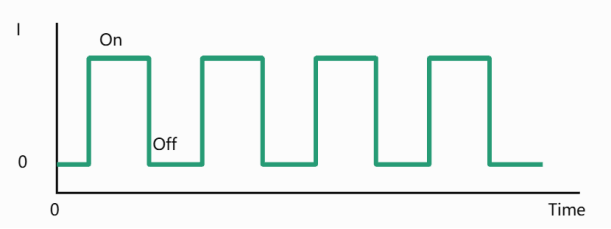
(Illustrative pulse-current waveform, not measured product data)
Potential Process Benefits
Pulse operation may provide several advantages under appropriate anodizing conditions:
1.Thermal management: Off-time intervals may allow partial relaxation of local thermal conditions.
2.Current control flexibility: Engineers can adjust peak current, frequency, and duty cycle.
3.Process optimization: Different pulse profiles can be evaluated for specific aluminum alloys and coating requirements.
4.Process consistency: A properly validated pulse profile may help manage electrical conditions across production batches.
However, pulse power does not automatically guarantee harder, thicker, or more uniform coatings. Actual results depend on electrolyte chemistry, cooling, alloy composition, workpiece geometry, and process settings.
3. Selection Guide: Pulse Power vs. Conventional DC
Choosing between continuous DC and pulse power depends on the production requirements.
Selection Factor | Conventional DC Power | Pulse DC Power |
Output mode | Continuous DC | Periodically controlled DC |
Current adjustment | Adjustable | Adjustable pulse parameters |
Duty cycle control | Not applicable to continuous output | Available where supported |
Process flexibility | Standard current control | Additional pulse control |
Thermal management | Depends on process cooling | Off-time may support thermal management |
System complexity | Generally simpler | Requires additional control configuration |
Application suitability | General anodizing | Processes benefiting from pulse optimization |
Key Parameters Buyers Should Confirm
Before selecting an adjustable DC power supply for hard anodization, engineers should evaluate:
Input voltage and phase
DC output voltage range
Maximum output current
Rated output power
Continuous operating capability
Pulse frequency range
Peak current capability
Duty cycle adjustment
Current regulation accuracy
Cooling configuration
Protection functions
Remote control requirements
One important consideration is whether the power supply supports the required peak current and average power simultaneously.
For pulse applications, these values should be evaluated separately to ensure the equipment can operate within its electrical and thermal ratings.
4. Technical Solution: Adjustable DC Power Supply for Anodizing
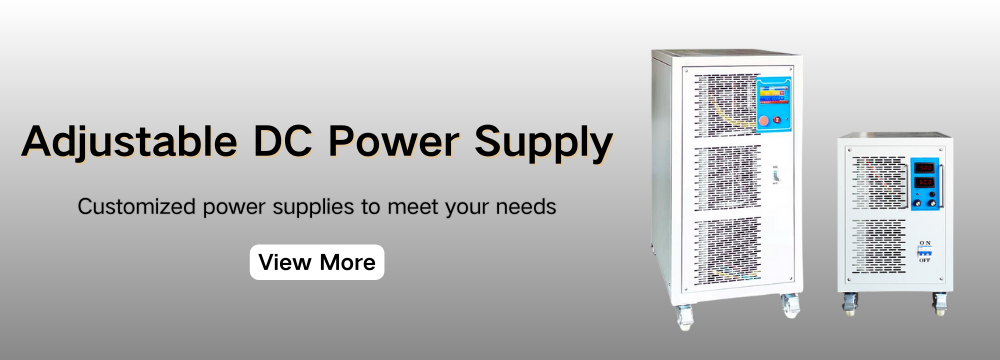
YIBENYUAN provides industrial adjustable DC power supply solutions for applications requiring controlled voltage and current output.
For hard anodization projects, the electrical configuration can be discussed according to the customer's process conditions.
The engineering evaluation may include:
Electrical Performance
·Required DC voltage and current
·Output adjustment range
·Current regulation
·Ripple requirements
·Continuous operating conditions
Pulse Configuration
Where pulse operation is required and supported by the selected configuration, engineers can discuss peak current, pulse frequency, duty cycle, and pulse timing.
Cooling and Protection
High-current anodizing applications require suitable thermal management. Cooling capacity, ambient temperature, installation conditions, and operating duration should be considered.
Protection requirements may include overvoltage, overcurrent, short-circuit, and overtemperature protection, depending on the equipment configuration.
Testing and Documentation
Before delivery, buyers can agree on project-specific verification requirements, such as output voltage, current, pulse waveform, operating stability, and protection-function testing.
Contact YIBENYUAN engineers to discuss your anodizing process and request relevant product specifications or technical documentation.
5. Application Case: Hard Anodizing of Industrial Aluminum Components
Consider an aluminum component manufacturer producing mechanical parts that require hard anodization for improved wear resistance.
The production team experiences variations in coating thickness and surface quality between different batches.
Instead of immediately changing the power supply, the engineering team should review the complete process:
1.Check electrolyte temperature and composition.
2.Review current density and treatment time.
3.Examine workpiece geometry and electrical contact.
4.Evaluate electrical output stability.
5.Compare conventional DC and pulse operating profiles through controlled trials.
If pulse operation is technically appropriate, the manufacturer can test different pulse frequencies, duty cycles, and peak current settings.
The evaluation should record:
·Coating thickness
·Surface hardness
·Surface appearance
·Electrolyte temperature
·Current density
·Treatment duration
·Rejection and rework rates
These measurements provide a basis for comparing different power-supply operating modes.
No verified customer-specific test results were provided for this article. Therefore, improvements in coating thickness, hardness, or defect rates should be established through actual production trials rather than assumed.
Conclusion
Pulse power introduces additional electrical control possibilities for hard anodization applications.
By adjusting peak current, pulse frequency, and duty cycle, manufacturers can investigate different operating profiles and evaluate their effects on coating quality and thermal conditions.
However, the effectiveness of pulse power depends on the aluminum material, electrolyte conditions, cooling system, and overall process design.
Selecting the right adjustable DC power supply requires more than comparing rated voltage and current. Engineers should also consider pulse capability, output regulation, continuous operating conditions, cooling, and verification requirements.
YIBENYUAN supports application-based power supply discussions for industrial anodizing and other DC power applications.
If you are evaluating a new hard anodization line or upgrading an existing rectifier, send us your application, required voltage and current, quantity range, target delivery market, and testing requirements to discuss a suitable solution.
FAQ
1. What is pulse power in hard anodization?
Pulse power is a method of delivering controlled DC current in repeated on-and-off intervals. It provides additional control over current delivery compared with continuous DC operation.
2. Why is pulse power used in hard anodizing?
It can provide additional flexibility in managing peak current, duty cycle, and pulse frequency. These parameters can be evaluated to optimize specific anodizing processes.
3. Does pulse power improve hard anodization coating quality?
It may improve certain process outcomes under suitable conditions, but results depend on electrolyte chemistry, temperature, alloy type, workpiece geometry, and electrical settings.
4. What is the difference between pulse DC and conventional DC anodizing?
Conventional DC provides continuous output, while pulse DC periodically changes the output according to configured pulse parameters.
5. What pulse frequency is suitable for hard anodization?
There is no universal frequency suitable for every hard anodizing process. The appropriate range depends on the power supply capabilities and process requirements and should be established through testing.
6. What power supply is suitable for aluminum hard anodizing?
An industrial adjustable DC power supply with suitable voltage, current, regulation, cooling, and continuous operating capability should be selected according to the anodizing process.
7. Can a conventional adjustable DC power supply support pulse anodizing?
Not necessarily. Pulse operation requires specific output switching and control capabilities. Buyers should verify whether the selected model supports the required pulse parameters.
8. What information is needed to customize an anodizing power supply?
Important information includes input voltage, output voltage, maximum current, rated power, continuous operating duration, pulse requirements, cooling conditions, quantity, and target delivery market.