1.The Reliance of Modern Water Treatment Processes on Power Supplies
In modern water treatment systems, the power supply is no longer just a simple energy supply unit, but a core component that directly affects treatment efficiency and effectiveness. From industrial wastewater treatment to seawater desalination, from municipal sewage treatment to special water quality purification, electrochemical methods are gradually replacing some traditional chemical treatment methods.
Compared with chemical treatment methods, electrochemical methods have significant environmental advantages, requiring no large amounts of chemical reagents, reducing secondary pollution, and offering more flexible operation, enabling automation and intelligent control.
Water treatment equipment using high-frequency switching power supplies typically achieves an efficiency improvement of more than 15% compared to traditional thyristor-based equipment, and the efficiency improvement can reach over 30% when the load rate is below 75%. This means lower energy consumption and more significant cost savings.
The core function of a water treatment power supply is to convert AC power into DC or pulsed DC power suitable for electrochemical reactions, providing power support for processes such as electrolysis, electrocoagulation, and electroflotation. The stability and accuracy of this conversion process directly relate to the water treatment effect.
2.Technical Challenges in Harsh Environments
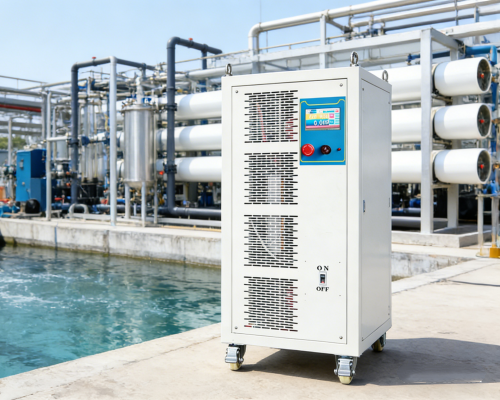
Water treatment facilities are typically characterized by highly corrosive, high-humidity, and dusty environments, posing a comprehensive challenge to power supply equipment. According to the HG/T 3133-2006 standard, water treatment equipment must maintain stable operation under extreme conditions.
Power supply equipment needs to withstand operating temperatures of 0-50℃ while ensuring that the relative humidity does not exceed 95%. In humid heat tests, the power supply must operate continuously for 48 hours at a temperature of 40℃ and a humidity of 93%, and the insulation resistance must remain above 5 MΩ after the test.
Different water treatment processes have different power supply requirements. Electrolytic treatment requires adjustable voltage and current to optimize reaction efficiency; electrocoagulation processes require a periodic polarity reversal function to prevent electrode passivation.
High-frequency high-voltage electrocoagulation technology requires the power supply to provide a high-frequency output adjustable from 800-35000Hz. Each process has unique requirements for power supply waveform, frequency, and stability, and general-purpose power supplies often fail to meet these specialized needs.
3.Interpretation of Core Performance Indicators
The core performance indicators of adjustable power supplies for water treatment can be evaluated from three dimensions: electrical characteristics, reliability, and adaptability. Each indicator is directly related to the stable operation and long-term benefits of the water treatment system.
Electrical stability is the primary indicator for water treatment power supplies. The output voltage fluctuation range should be controlled within ±5%, and the ripple should be less than 100mV. High-efficiency water treatment power supplies can achieve conversion efficiencies of over 90%.
Reliability and protection determine the service life of the power supply. Excellent industrial power supplies have an average mean time between failures (MTBF) of over 50,000 hours.
Protection functions include soft start protection, input and output overvoltage and overcurrent protection, and overtemperature protection, effectively preventing damage to the equipment caused by power grid fluctuations and load abnormalities.
Environmental adaptability is equally important. Water treatment power supplies should support a wide voltage input range, such as 90-264VAC, to cope with power grid fluctuations. The temperature adaptation range should be between -10℃ and 55℃, and in extreme cases, it can reach -45℃ to 50℃.
4.Comparison of Three Mainstream Adjustable Power Supplies
High-Frequency Switching Power Supply
This type of power supply uses a high-frequency transformer design, significantly improving conversion efficiency. Under normal circumstances, it is more than 15% more efficient than traditional thyristor devices, and the efficiency improvement can reach more than 30% when the load rate is below 75%.
The output accuracy of high-frequency switching power supplies is usually better than 1%, the system response speed is fast, and it has strong adaptability to power grid and load changes. The high operating frequency facilitates the adjustment of the output waveform according to user process requirements, which plays an important role in improving work efficiency and treatment effect.
This type of power supply supports remote/local control, and the modules use a fully digital dual-channel dual-hot backup network control system, which has fast response speed and high reliability.
Power Supply for Electrocoagulation
This type of power supply is specifically designed for electrocoagulation processes and supports automatic periodic commutation. The adjustable range of the polarity reversal time is usually 10-40 seconds to prevent electrode passivation. The output is a pulsed square wave, with a frequency that can be arbitrarily set within the range of 100Hz-3000Hz.
Electrocoagulation power supplies support constant voltage/constant current conversion and have multiple built-in protection mechanisms, including overvoltage, undervoltage, phase loss, and overtemperature protection. Cooling methods can be air-cooled or water-cooled, and some models weigh approximately 100kg, making them easy to transport and install.
Industrial-grade programmable power supplies
The main feature of these power supplies is that the output voltage and current are continuously adjustable, and the voltage and current stabilization functions greatly increase customer flexibility.
Built into advanced industrial-grade programmable power supplies is a function generator, capable of producing arbitrary waveforms—including those for complex applications like battery testing and fuel cell simulation.
Multiple communication interfaces are supported, such as RS232, RS482, Profibus, and Ethernet, streamlining integration with automation control systems.
An automatic range function is also a common feature of these power supplies, delivering high power across a broad voltage and current range. This lets a single device satisfy diverse process requirements.
5.Selection Strategy for Water Treatment Power Supplies
The selection of water treatment power supplies must be based on a comprehensive consideration of specific application scenarios and process requirements. Incorrect selection will not only lead to poor treatment results but may also increase operating costs and maintenance burden.
First, the power supply type should be selected according to the type of water treatment process. High-frequency switching power supplies are suitable for electrolytic treatment; electrocoagulation processes require dedicated power supplies with periodic commutation functions; and for research applications requiring flexible parameter adjustment, industrial-grade programmable power supplies are more suitable.
Secondly, key technical parameters of the power supply must be taken into account: meeting process requirements is imperative for output power, and sufficiently wide voltage and current adjustment ranges are a must to cater to different water quality and treatment effect demands.
Directly impacting operating costs is conversion efficiency—thus, high-efficiency products should be prioritized. Environmental adaptability, including temperature range and protection level (e.g., IP67), must align with on-site conditions.
Finally, evaluate the overall strength of the supplier. An excellent water treatment power supply supplier should have a complete quality management system and relevant certifications; have rich industry application experience and successful cases; and be able to provide comprehensive technical support and service guarantees.
6.Practical Applications in Demanding Scenarios
Water treatment power supplies have diverse application scenarios, each with specific requirements for the power supply.
In the field of industrial wastewater treatment, when dealing with wastewater containing heavy metals and toxic organic substances, high-frequency switching power supplies with easily modulated output waveforms are needed to optimize treatment results by changing the output waveform. For challenging wastewater treatment applications, such as electroplating wastewater and circuit board wastewater with high oil content, high-frequency high-voltage electrocoagulation power supplies demonstrate significant advantages.Their adjustable output frequency range of 800-35000Hz allows for effective treatment of pollutants that are difficult to degrade using traditional methods.
In municipal wastewater treatment and seawater desalination, water treatment power supplies need to be highly efficient and energy-saving, while also supporting modular design and remote control to meet the demands of large-scale continuous operation.
For applications in special environments, such as high-altitude regions or corrosive coastal environments, power supplies require a wide operating temperature range and a high protection rating.
In summary, water treatment power supplies are indispensable core equipment in modern water treatment systems, closely linked to the efficiency, effectiveness, and operational costs of water treatment processes. As water treatment technology continues to develop towards intelligence and specialization, water treatment power supplies will also evolve in the direction of higher efficiency, stronger adaptability, and more flexible programmability, providing more solid support for environmental protection and water resource recycling in various demanding scenarios.